How 3D printing could make better cooling systems
New manufacturing techniques could improve heat exchangers in everything from air conditioners to massive ships.
A new 3D-printed design could make an integral part of cooling systems like air ...
MIT Technology Review The Big Story Artificial intelligence Biotech & health Climate & energy 10 Breakthrough Technologies EmTech Future live event The Kids issue Menu MIT Technology Review MIT Technology Review The Big Story Artificial intelligence Biotech & health Climate & energy 10 Breakthrough Technologies EmTech Future live event The Kids issue Climate change and energy How 3D printing could make better cooling systems New manufacturing techniques could improve heat exchangers in everything from air conditioners to massive ships.
A new 3D-printed design could make an integral part of cooling systems like air conditioners or refrigerators smaller and more efficient, according to new research.
Heat exchangers are devices that whisk away heat, and they’re everywhere—used in data centers, ships, factories, and buildings.
The aim is to pass as much heat as possible from one side of the device to the other.
Most use one of a few standard designs that have historically been easiest and cheapest to make.
“Heat exchangers are at the center of the industrial economy.
They’re an essential part of every machine and every system that moves energy,” says William King, a professor at the University of Illinois Urbana-Champaign and one of the authors of the new study .
Existing designs tend to favor straight lines, right angles, and round tubes, he adds.
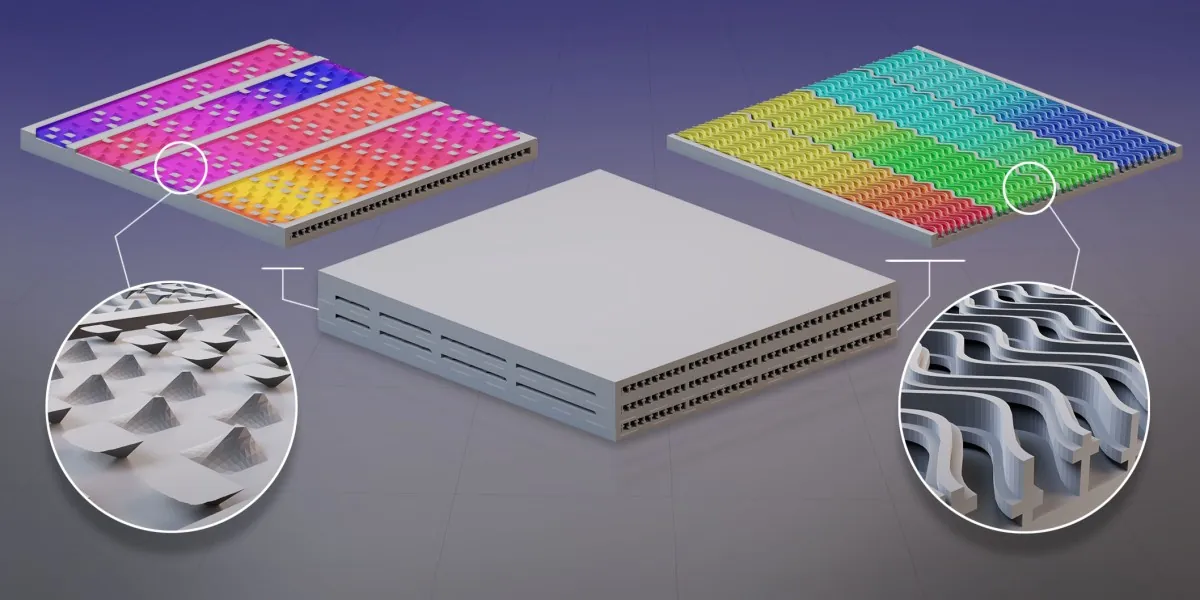
King and his colleagues used 3D printing to design a heat exchanger that includes features to optimize heat movement, like wavy walls and pyramid-shaped bumps, which wouldn’t be possible to make using traditional manufacturing techniques.
The team had set out to design a system based on a common refrigerant called R-134a, which is commonly used in devices like air conditioners and refrigerators.
When cold water lowers the temperature of the refrigerant, it changes from a gas to a liquid on its path through the device.
That liquid refrigerant can then go on to other parts of the cooling system, where it’s used to lower the temperature of anything from a room to a rack of servers.
The best way to cool the refrigerant tends to involve building very thin walls between the two sides of the device and maximizing the amount of contact that the water and the refrigerant make with those walls.
(Think about how much colder you’d get wearing a thin T-shirt and pants and lying down on ice than simply touching it with your gloved hands.) To design the best possible heat exchanger, researchers used simulations and developed machine-learning models to help predict the performance of different designs under different conditions.
After 36,000 simulations, the researchers landed on the one they decided to develop.
Among the key components: small fins that jut out on the side of the device that touches the water, increasing the surface area to maximize heat transfer.
The team also designed wavy passageways for the water to pass through—once again helping to maximize surface area.
Simulations helped the researchers figure out exactly how curvy the passages should be and where precisely to place the fins.
On the side of the devices where the refrigerant passes through, the design includes small pyramid-shaped bumps along the walls.
These not only maximize the area for cooling but also help mix the refrigerant as it passes through and prevent liquid from coating the wall (which would slow down the heat transfer).
Related News
- ChemicalReport: Texas' Chemical Plant Expansion Affects POC Areas
- ChemicalVerbio commissions large-scale ethenolysis plant for bio-based chemicals in Bitterfeld, Germany
- ChemicalForgotten oil and gas wells linger, leaking toxic chemicals
- ChemicalDirt on the back of the air conditioner heat exchanger [Fukuoka] | What happens on the side you cannot see from the front, and how to clean it
- ChemicalHeat Exchanger Market Analysis Report: 13,851 Million USD in 2026, 3.9% Growth Rate
- ChemicalInnovative Heat Exchanger Technology Enhances Proven Designs