Innovative Heat Exchanger Technology Enhances Proven Designs
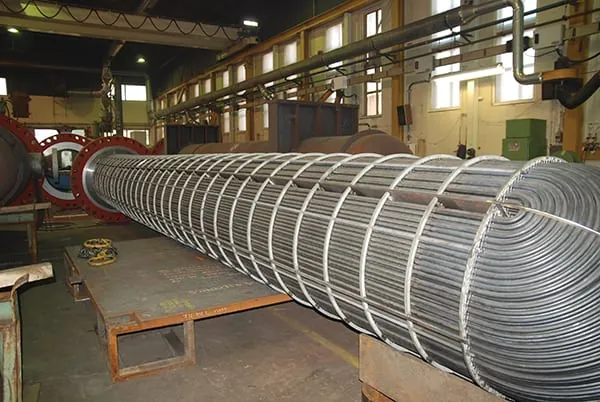
They say you can’t teach an old dog a new trick, but sometimes you can upgrade your dog.
Innovations, such as twisted tubes, expanded metal baffles, graphene-coated surfaces, and more are improving ...
Search Sign In Home Plant Design Innovative Heat Exchanger Technology Enhances Proven Designs Plant Design Innovative Heat Exchanger Technology Enhances Proven Designs POWER They say you can’t teach an old dog a new trick, but sometimes you can upgrade your dog.
Innovations, such as twisted tubes, expanded metal baffles, graphene-coated surfaces, and more are improving heat exchanger and condenser performance, making some upgrades worth considering.
Shell-and-tube heat exchangers have been around longer than anyone reading this article.
The heat exchanger offers many advantages.
It can be used in condensing, boiling, or single-phase applications; it can be utilized over a wide range of pressures and temperatures; it can be constructed from a variety of materials to meet corrosion and other design requirements; maintenance is fairly simple and straightforward; and it can accommodate various physical orientations.
However, there are some limitations to the design.
The conventional shell-and-tube heat exchanger contains baffles on the shell side to provide support and direct flow through a circuitous course across the tubes.
The downside is that low-flow areas, or dead zones, result in the vicinity of the baffles where fouling can occur, corrosion can go unchecked, and heat transfer is reduced.
The directional changes caused by the baffles also consume energy, and the shell-side pressure decrease can be significant.
The classic design is also prone to flow-induced tube vibration, which can ultimately result in failure.
With these problems in mind, it’s not surprising that engineers have continued to conduct research to enhance the shell-and-tube design, resulting in new technology that improves heat exchanger performance, counteracts fouling problems, saves space, reduces cost, and increases efficiency.
One group that is leading the way in this effort is Heat Transfer Research Inc.
Based in Navasota, Texas, HTRI is a research and software development company that tests various exchanger types and heat transfer surfaces.
Its staff conducts application-oriented research on equipment and uses these proprietary data to develop methods and software for the thermal design and analysis of heat exchangers and fired heaters.
Its research includes physical testing, computational fluid dynamics, and flow visualization.
“HTRI has and continues to investigate new commercialized exchanger types such as plate and shell or helical baffle exchangers,” said Joe Schroeder, senior vice president of technical programs for HTRI.
In the helical baffle heat exchanger that Schroeder mentioned, quadrant-shaped plate baffles are placed at an angle to the tube axis in a sequential arrangement to create a helical flow pattern.
The helical flow design improves thermal effectiveness, enhances heat transfer, reduces pressure loss, lessens fouling, and significantly reduces vibration concerns.
One manufacturer of the helical style, CB&I, says the design is well proven with more than 1,800 of its HELIXCHANGER heat exchangers in operation worldwide.
In addition to the helical baffle design, Schroeder noted that expanded metal baffles are also revolutionizing the industry.
The design—patented by EMbaffle B.V., a group company of Italy-based Brembana & Rolle—features an expanded metal baffle grid made of plate material that has been slit and expanded (Figure 1).
The expanded metal baffles create an open flow structure, allowing longitudinal flow on the shell side, which reduces pressure loss in the heat exchanger.
Expanded metal is used in many power plant applications, but running tubes through the diamond-shaped voids in a heat exchanger is a fairly recent development.
The shell-side fluid flows along the tubes and the flow area is constricted at each baffle cross, creating localized turbulence and increased velocity while breaking up the boundary layer around the tubes.
The grid shape induces a local cross-flow component in addition to the longitudinal bulk-flow pattern, improving heat transfer characteristics of the heat exchanger.
Related News
- ChemicalReport: Texas' Chemical Plant Expansion Affects POC Areas
- ChemicalVerbio commissions large-scale ethenolysis plant for bio-based chemicals in Bitterfeld, Germany
- ChemicalForgotten oil and gas wells linger, leaking toxic chemicals
- ChemicalDirt on the back of the air conditioner heat exchanger [Fukuoka] | What happens on the side you cannot see from the front, and how to clean it
- ChemicalHeat Exchanger Market Analysis Report: 13,851 Million USD in 2026, 3.9% Growth Rate
- ChemicalHeat Exchanger Market to Hit $33 Bn By 2032, Says Global Market Insights Inc.