The fire triangle on heavy equipment: Why prevention alone is not enough
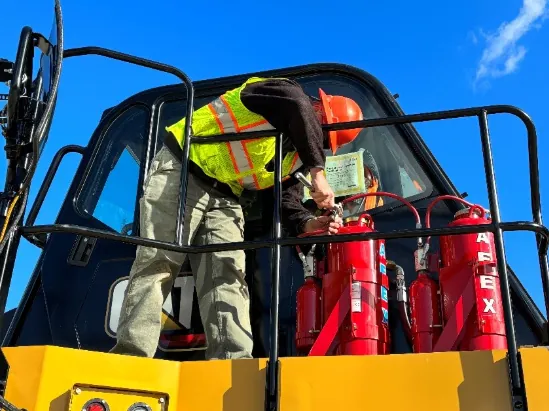
The fire triangle — heat, fuel and oxygen — is one of the simplest concepts in fire safety.
The fire triangle — heat, fuel and oxygen — is one of the simplest concepts in fire safety.
It is especially important for heavy mining equipment because all three elements are present during normal operation.
Engines, exhaust components, turbochargers, brakes and electrical systems generate heat.
Diesel fuel, hydraulic fluid, lubricants, hoses, wiring insulation and debris provide fuel, while air supplies oxygen.
Inspections and maintenance reduce ignition risk, but failures still occur.
Mining operations need prevention and protection.
For mining operations, the strongest strategy is not prevention or fire protection.
Fire requires heat, fuel and oxygen; removing one prevents combustion.
On mining equipment, however, heat-producing systems and combustible materials share compact spaces.
Wear, damage, debris, maintenance changes or component failure can increase risk.
Leaking hydraulic hoses, damaged electrical insulation and accumulated oil or debris can complete the fire triangle.
Because equipment ages and operating conditions change, fire risk must be reassessed throughout the machine’s life.
Heavy equipment is designed to generate and manage significant heat.
Engines, exhaust manifolds, turbochargers, brake systems and other components routinely operate at elevated temperatures.
In most cases, that heat is expected and controlled.
The concern begins when combustible material reaches an area where it was never intended to be.
A damaged hose or fitting can allow hydraulic oil, diesel fuel or another combustible fluid to contact a hot component.
Electrical faults create another possible ignition source.
Damaged wiring, loose connections, short circuits and deteriorated insulation can generate heat or arcing capable of igniting nearby material.
The fire triangle — heat, fuel and oxygen — is one of the simplest concepts in fire safety.
It is especially important for heavy mining equipment because all three elements are present during normal operation.
Engines, exhaust components, turbochargers, brakes and electrical systems generate heat.
Diesel fuel, hydraulic fluid, lubricants, hoses, wiring insulation and debris provide fuel, while air supplies oxygen.
Inspections and maintenance reduce ignition risk, but failures still occur.
Mining operations need prevention and protection.
For mining operations, the strongest strategy is not prevention or fire protection.
Fire requires heat, fuel and oxygen; removing one prevents combustion.
Related News
- MiningIndia's 97 GW Coal Expansion Plan Looks Too Small, Senior Official Says
- MiningExplosives: The overlooked risk that could halt mines
- MiningOp-Ed: AI will not just add copper demand. It could change who sets the price
- MiningSouth America’s copper boom faces a $170B reality check
- MiningHertha Metals breaks ground on $100M US plant for magnet-grade iron
- MiningEnergyX inks 10-year, $2B lithium offtake deal with Trafigura