Steam Turbine Cleaning Using Chemical Foams
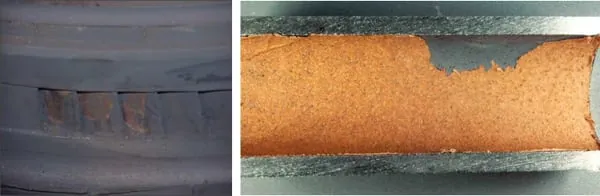
In the May issue, we discussed the importance of either preventing copper plating of the high-pressure (HP) steam turbine rotor or finding a good foam or mechanical removal means of restoring lost ...
Search Sign In Home O&M Steam Turbine Cleaning Using Chemical Foams O&M Steam Turbine Cleaning Using Chemical Foams POWER In the May issue, we discussed the importance of either preventing copper plating of the high-pressure (HP) steam turbine rotor or finding a good foam or mechanical removal means of restoring lost efficiency.
In that article we noted that “copper deposits typically form on the stationary nozzle block or first-stage stationary blades” and that those deposits usually result in a steam turbine loss of capacity at a rate of about 2 to 3 MW per month.
We also stated that the “general rule of thumb is that there is a reduction of about 1 MW of generating capacity for each 1 to 2 pounds of deposit that accumulates on the HP turbine.
Danny Foster, product line manager for Aquilex HydroChem, suggests that this rule of thumb has some limitations, based on his experience of chemical cleaning more than 450 steam turbines over the past 25 years.
Foster points out that although copper may plate throughout the HP turbine stages, the deposits on the early stages of the HP turbine have a much larger effect on performance than on the last stages.
That earlier article also discussed the water chemistry issues related to copper loss from the condenser and other feedwater heaters that finds its way to the HP turbine blades.
In this article, we look at the process of cleaning the blades of the copper.
Dissolved copper oxide from the corrosion of copper tubing in condensers and feedwater heaters often carries over into the boiler water cycle and—with the right combination of temperatures, pressures, and water chemistry—can plate out on the blades in the HP section of a steam turbine.
These deposits change the aerodynamics of the steam path components and result in reduced unit generating capability and increased heat rate (Figure 1).
Foam cleaning of steam turbines has been found to be an acceptable and cost-effective method of removing deposits from turbines without disassembly.
The entire cleaning process can be completed in 24 hours or less but will require about a five-day outage to cool the turbine to the desired temperature and perform all the required mechanical tasks.
Once the process is complete, the turbine can be placed back into service, and full capacity is normally restored.
The necessary connection points into the steam turbine must be carefully selected.
Low-pressure steam combined with the cleaning foam is injected into the steam turbine and removed through the cold reheat line.
Other drains and vents are also used during the cleaning process, such as a spent solvent drain, anti-foam injection points, and a system vent.
The location of these connections are steam-turbine-specific.
Careful consideration is also given to sealing of the turbine valve stems, shaft seals, and condenser and feedwater heater protection.
In This Issue November, 1 2011 Full issue Commentary Power Grid Cybersecurity: How to Achieve Results in an Uncertain Regulatory Environment Commentary California’s RAM for Small Renewables Commentary A Renaissance for U.S.
Not Anytime Soon HR Why Meetings Fail and How to Make Them Work HR Navigating the World of Social Media and the Job See more stories Business Legal Issues That Float in the Cloud Finance Solar Power’s Elephant in the Living Room Finance Public Power Challenges Moody’s Proposed New Metrics Legal & Regulatory TREND: Aches and Pains of Aging Nukes Commentary The Lesson of Procrustes The process of cleaning begins with equipment setup and premixing chemicals the day before starting the scheduled cleaning, while waiting for the steam turbine to cool to approximately 170F.
Typically, 3,000 gallons of solution are premixed.
Making all the connections to the turbine requires about 10 to 12 hours, spread over two days, including during turbine cooldown.
The cleaning process uses foaming CuSol I, Aquilex HydroChem’s copper oxide removal chemistry, with injections of an oxidizer to remove elemental copper.
Following completion of the cleaning process, the turbine is rinsed with foamed condensate followed by a saturated steam rinse until the conductivity of the rinse water reaches an acceptable level.
CuSol I is a proprietary chemical that rapidly dissolves and removes copper oxide.
Related News
- Power GenerationU.S. electricity use for electric vehicles increasing at a slower pace in 2026
- Power GenerationEquinor to feed Dutch grid with low-emission Norwegian gas through 2031
- Power GenerationInter-array cable installation about to start at 2.9 GW UK offshore wind farm
- Power GenerationØrsted expands offshore wind ROV fleet with third Saab electric subsea robot
- Power GenerationCoastal gridlock: California’s infrastructure ban and Gulf pushbacks trigger an energy tug-of-war
- Power GenerationAfentra partners send Borr Grid rig to Impala-2 ahead of Pacassa SW sidetrack