[Interview With Top Engineer] Doosan Enerbility: "First 380MW-Class Test Success in Korea, A New Heart for Global Competition"
Doosan Enerbility recently passed the rated load test for a 380MW (megawatt) class gas turbine for power generation, marking the first time this has been achieved in Korea.
[Interview With Top Engineer] Doosan Enerbility: "First 380MW-Class Test Success in Korea, A New Heart for Global Competition" Doosan Enerbility recently passed the rated load test for a 380MW (megawatt) class gas turbine for power generation, marking the first time this has been achieved in Korea.
After becoming the fifth company in the world to secure large gas turbine technology in 2019, Doosan Enerbility has now improved output with this achievement, which enables the production of 380,000 kW of electricity per second, thereby gaining the competitiveness to stand alongside leading global companies.
Yook Simkyun, Executive Vice President and Head of Technology Innovation at Doosan Enerbility, is a living witness to Korea’s self-reliance in gas turbine technology.
The foundation for Korea’s acquisition of power generation gas turbine technology?which had previously been held by only four countries: the United States, Germany, Japan, and Italy?was laid by extensive experience and an organically collaborative culture.
Yook explained, "Engineers who have worked for more than 30 years are part of an organization that has been maintained for 63 years." Having majored in mechanical engineering, he joined what was then Korea Heavy Industries and Construction in 1993, gaining experience in turbine control system development and materials research.
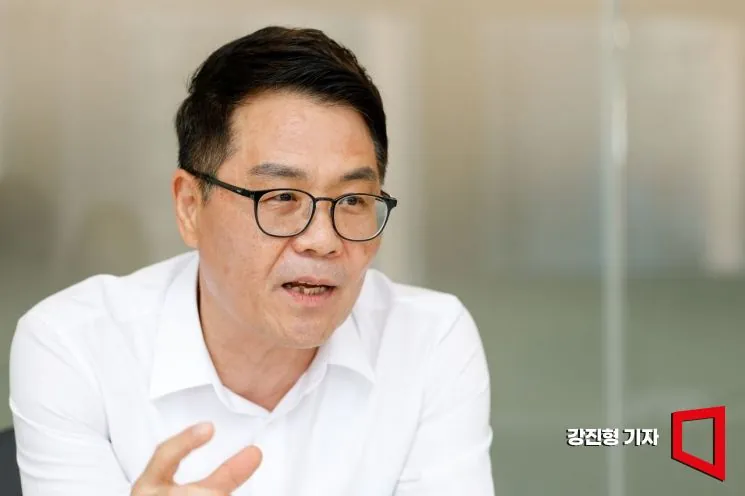
Yuk Simkyun, Executive Vice President and Head of Technology Innovation at Doosan Enerbility, is being interviewed on the 18th at Doosan Tower Bundang, Seongnam, Gyeonggi Province.
Photo by Kang Jinhyung Gas turbines are among the most challenging single mechanical devices to develop.
Known as the "heart of the power plant," this massive machine generates electricity by burning fuel as it rotates.
Each turbine contains more than 40,000 parts.
It measures 12 meters in length and weighs 320 tons.
In 2013, Chairman Park Ji-won announced a 1 trillion won investment to begin localization, and in 2019, the company succeeded in developing a 270MW class turbine.
Doosan Enerbility’s gas turbine features a precision structure that combines special alloys with cooling and coating technologies, enabling it to withstand ultra-high temperature combustion gases of up to 1,600 degrees Celsius.
Yook Simkyun emphasized, "Since the conditions cannot be handled by alloys alone, all three technologies must operate simultaneously," and added, "We have tested various alloy compositions, designed the cooling technology to minimize its impact on power generation efficiency, and are advancing the coating technology to make it as thin and strong as possible." The core of the materials research is a super heat-resistant alloy based on nickel, combined with chromium and cobalt.
Aluminum and titanium are added to increase strength and stability, while expensive elements such as molybdenum, rhenium, and hafnium are incorporated to further enhance strength.
Multiple manufacturing methods are used, including "single crystal casting," which creates a single metal crystal during alloying, to ensure the material maintains its strength and resists damage even in high-temperature environments over extended periods.
Doosan Enerbility's self-developed 380MW (megawatt) class gas turbine model.
Yonhap News In addition to these alloys, two supplementary technologies are used to control the high-temperature combustion gases.
First, a ceramic coating is applied to the exterior, reducing the surface temperature by up to 300 degrees Celsius.
Second, a cooling structure injects air through tiny channels inside the turbine, lowering the temperature by an additional 300 degrees Celsius or more.
Yook explained, "The core technology is the 'film cooling' structure, where cold air spreads like a film over the outer wall of the turbine blade.
Since turbine blades are directly exposed to combustion gases and suffer severe material damage, forming an air barrier minimizes thermal damage to the material." Doosan Enerbility efficiently utilizes cooling air through small holes about 0.7mm in diameter.
Related News
- Power GenerationU.S. electricity use for electric vehicles increasing at a slower pace in 2026
- Power GenerationEquinor to feed Dutch grid with low-emission Norwegian gas through 2031
- Power GenerationInter-array cable installation about to start at 2.9 GW UK offshore wind farm
- Power GenerationØrsted expands offshore wind ROV fleet with third Saab electric subsea robot
- Power GenerationCoastal gridlock: California’s infrastructure ban and Gulf pushbacks trigger an energy tug-of-war
- Power GenerationAfentra partners send Borr Grid rig to Impala-2 ahead of Pacassa SW sidetrack