Houthi Attacks on Saudi Arabia Defy Difference in Military Power
The Houthi attacks on Saudi Arabia are demonstrating the limits of the kingdom’s military prowess — despite defense spending that far outstrips that of its regional neighbors.
Essential news coupled with the finest maritime content sourced from across the globe.
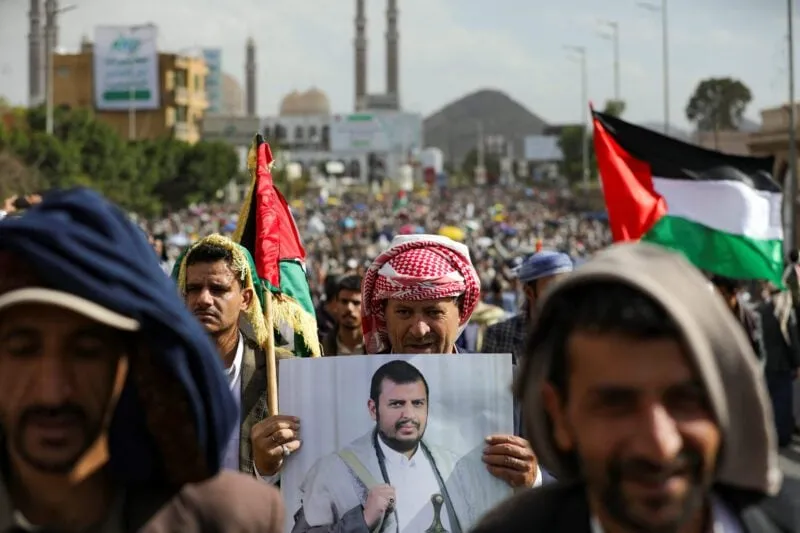
Protesters, predominantly Houthi supporters, rally on the first Friday of the fasting month of Ramadan, to show continued support to the Palestinians in the Gaza Strip, in Sanaa, Yemen, March 15, 2024.
REUTERS/Khaled Abdullah By Gerry Doyle (Bloomberg) — The Houthi attacks on Saudi Arabia are demonstrating the limits of the kingdom’s military prowess — despite defense spending that far outstrips that of its regional neighbors.
Missiles and drones fired by the Iran-backed group from Yemen have wreaked havoc in Saudi Arabia in recent days, killing at least 18 people and forcing the closure of the country’s main international airport in Riyadh.
The Houthis are showing no sign of scaling back their campaign, targeting several Saudi Arabian cities in an assault this week that’s continued into Thursday.
Saudi Arabia allocated between $64 billion and $96 billion this year for defense, according to data compiled by Bloomberg Economics.
The upper end is more than twice as much as Israel, the next biggest Middle East spender.
Patriot missile batteries with the latest Lockheed Martin Corp.
PAC-3 interceptors, flies hundreds of Boeing Co.
F-15 fighters customized for its air force, and is the only Gulf country with mid-air refueling aircraft.
One reason the Houthis have been able to cause such destruction with less advanced equipment is Saudi Arabia’s size, which complicates defense efforts.
The kingdom covers more than 2.1 million square kilometers (830,000 square miles), with many strategic targets to protect, from oil infrastructure to air bases to several large cities.
Defending against ballistic missiles is complex when protecting a single target, let alone sites sprinkled across a vast country.
Thousands of Iranian strikes across the Arabian peninsula during the initial phase of the US and Israeli war on the Islamic Republic were largely thwarted by missile defenses, but even a 90% success rate can mean massive damage on the ground.
Saudi Arabia’s military is also still in the process of modernizing and remains heavily reliant on the US for military intelligence.
The most recent rounds of Houthi strikes on Saudi Arabia have tended to involve a mix of weapons that further complicate defensive efforts: small drones, low-flying, cheap cruise missiles and ballistic missiles.
In addition, the Houthis are a nimble, rapidly evolving opponent backed by Iran, capable of building and deploying missiles and drones that can challenge even advanced defense systems.
Years of fighting in Yemen mean the group is battle hardened, resisting protracted military efforts to dislodge or contain them.
“The Houthis are partly beneficiaries of good fortune, but they seem remarkably adaptive,” said Ankit Panda, Stanton Senior Fellow in the Nuclear Policy Program at the Carnegie Endowment for International Peace.
“A determined attacker armed with missiles is still difficult to deal with.” The Houthi arsenal has now evolved to the point where the group can manufacture relatively precise drones and ballistic missiles — some of which rely on parts from Chinese companies.
Those munitions might cost thousands, or hundreds of thousands of dollars, far cheaper than the multimillion-dollar air defense interceptors used to stop them.
That means even a successfully intercepted attack imposes further costs on Saudi Arabia, and makes it more vulnerable to future strikes.
Defensive weapons such as the Iranian-made 358 surface-to-air missiles — which can loiter at high altitudes and strike subsonic aircraft — make the skies over Yemen dangerous too.
Another issue, said Bloomberg Economics defense lead Becca Wasser, is that Patriot air defense batteries are directional.
They do not cover a 360-degree area, so if radars and launchers were positioned to intercept Iranian fire, they may not have been able to easily shoot down Houthi missiles, she said.
Air and missile capabilities have improved as part of Saudi Arabia’s modernization efforts, Wasser said.
Related News
- LNGSuper El Niño Could Ease Asia’s LNG Supply Concerns
- LNGPakistan Faces $1 Billion LNG Bill This Winter
- LNGShell Slams Australia's Plan to Force LNG Producers to Supply Domestic Market
- LNGChina’s $3 Billion Qatar LNG Deal Raises an Awkward Question
- LNGShell, GTT, and Lloyd’s Register eye hybrid-electric LNG carrier design
- LNGNew wind for hydrogen-electric shipping as GMI-PowerCell collaboration expands to four bulk carriers