Fog of War Deepens in Hormuz as UKMTO Says Most Ship Attacks Go Unreported
Conflicting traffic figures and competing claims of control are making it increasingly difficult to establish what’s happening in the Strait of Hormuz, even as attacks on merchant shipping intensify.
Essential news coupled with the finest maritime content sourced from across the globe.
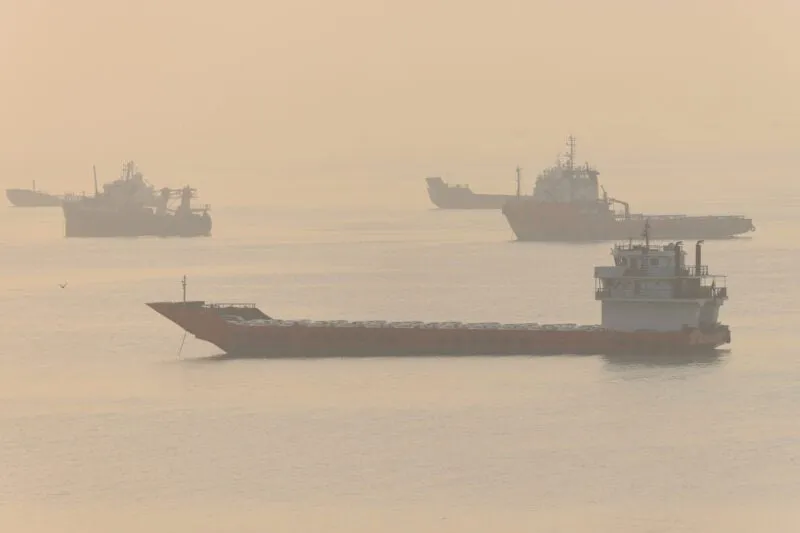
Vessels in the Strait of Hormuz near the beach of Bandar Abbas, Iran, September 28, 2026.
Amirhosein Khorgooi/ISNA/via WANA (West Asia News Agency) via REUTERS Conflicting traffic figures and competing claims of control are making it increasingly difficult to establish what’s happening in the Strait of Hormuz, even as attacks on merchant shipping intensify.
The true extent of attacks on merchant ships in the Strait of Hormuz remains unclear, with a new report from UK Maritime Trade Operations (UKMTO) acknowledging that most vessels struck in the region are not reporting incidents directly to the maritime security organization.
The admission comes as the United States and Iran offer sharply different accounts of who controls the vital waterway, while conflicting transit figures raise further questions about how much commercial shipping has actually recovered.
In its weekly overview published Friday , UKMTO said it is struggling to establish the true number of attacks because the majority of vessels targeted are refusing to submit reports.
UKMTO said it is aware of additional incidents through other sources but cannot include them in its reporting without sufficient verification.
The disclosure raises questions about the reliability of publicly available attack statistics, particularly following a sharp escalation in strikes against commercial vessels over the past two weeks.
UKMTO recorded 12 attacks during its latest reporting period, including 10 in the Strait of Hormuz, one in the Arabian Gulf and one in the Gulf of Oman.
Six vessels continued their voyages or reached port, two were disabled or left not under command, and three had unconfirmed damage or outcomes.
One vessel, the Singapore-flagged containership GFS Pride , was lost after being struck by a projectile.
The report also found that 55 of 74 documented projectile strikes since July 6 occurred along the southern route through the strait, accounting for nearly three-quarters of the reported attacks.
The findings stand in contrast to increasingly confident statements from U.S.
military officials about their control of the waterway.
Central Command, said American forces and regional partners remain firmly in control of the strait despite continued Iranian attacks.
“Let me be clear: the Strait of Hormuz is controlled by the United States and our regional partners, not Iran.
And it remains open for business,” Cooper said.
He reported that approximately 400 merchant ships had transited the strait over the preceding seven days, while U.S.
forces helped Gulf partners move more than 100 million barrels of crude oil during the same period.
Cooper said those shipments added to more than 1.3 billion barrels of crude transported with U.S.
For the seven days ending October 14, UKMTO recorded 254 combined transits, including 129 inbound and 125 outbound movements.
That was down from 275 the previous week, with traffic remaining approximately 70% below pre-conflict levels.
Of those 254 movements, just 42 were observed through Automatic Identification System (AIS) data.
The remaining 212 were drawn from U.S.-reported facilitated transits, which include ships operating without broadcasting AIS.
Related News
- LNGSuper El Niño Could Ease Asia’s LNG Supply Concerns
- LNGPakistan Faces $1 Billion LNG Bill This Winter
- LNGShell Slams Australia's Plan to Force LNG Producers to Supply Domestic Market
- LNGChina’s $3 Billion Qatar LNG Deal Raises an Awkward Question
- LNGShell, GTT, and Lloyd’s Register eye hybrid-electric LNG carrier design
- LNGNew wind for hydrogen-electric shipping as GMI-PowerCell collaboration expands to four bulk carriers