Controversial Kalama Methanol Plant Secures Investment from Hafnia
The backers of a proposed methanol plant at the small port of Kalama, Washington have received a $10 million investment commitment from tanker operator Hafnia, the second shipping line to take an ...
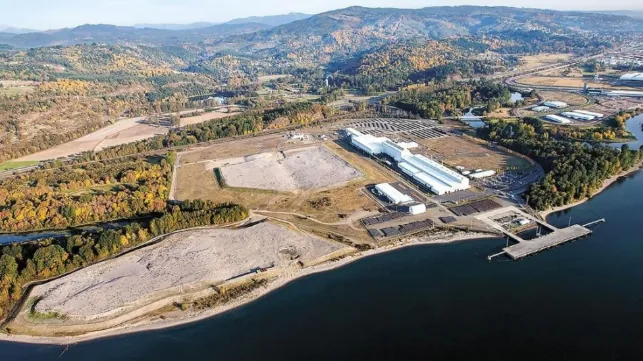
--> Log In SUBSCRIBE FREE Wednesday, October 14, 2026 Media Kit Subscribe TOP STORIES 6726 Views Controversial Kalama Methanol Plant Secures Investment from Hafnia The proposed methanol plant site at Port of Kalama (NWIW) By The Maritime Executive 2020-09-17 19:24:23 The backers of a proposed methanol plant at the small port of Kalama, Washington have received a $10 million investment commitment from tanker operator Hafnia, the second shipping line to take an equity stake in the complex.
Northwest Innovation Works - a venture spearheaded by state-owned Shanghai Bi Ke Clean Energy Technology Co.
- is planning a $2 billion natural gas-to-methanol petchem plant at Port of Kalama, a town on the Columbia River about 70 river miles inland from the Pacific.
The 3.6 million tonnes per annum plant would use West Coast-sourced gas to produce about one MR tanker's worth of cargo every four days.
After contributing $10 million in equity, Hafnia would carry one-third of the plant's volume for 19 years on a long term charter; in a press release, Hafnia said that the charter promises a "satisfactory guaranteed return." Mitsui O.S.K.
Lines (MOL) made a similar investment in June, and it will be carrying the balance of the cargo volume.
“You have forward-thinking, intelligent people who are committing and investing and wanting to see this go forward,” NWIW chief commercial officer Kent Caputo told the local Daily News.
If the gas-consuming Kalama facility displaces (rather than augments) the production of future higher-emission, coal-based methanol plants, the project would reduce net carbon emissions on a global basis, according to the Washington State Department of Ecology.
Its onsite carbon emissions would rank it among the 10 largest emitters of CO2 in the state, but it would offset this state-level impact by sponsoring carbon-uptake projects.
In keeping with the nature of the project, Hafnia will use new methanol-fueled ships for its long-term cargo charter.
However, the partners have promised that they will not use the Kalama plant's methanol as fuel.
Instead, they will bunker overseas, preserving the cargo for use in plastics production.
According to a recent study by DNV GL, methanol from natural gas is the most carbon-intensive marine fuel under consideration on a well-to-propeller basis - exceeding the emissions of HFO by about 10 percent to produce an equivalent amount of energy.
In the destination markets in China where these vessels will call, a substantial portion of the methanol supply is derived from coal, a more carbon-intensive fuel.
The project's opponents have raised related questions about the potential use of Kalama's output as a transportation fuel, which would result in higher CO2 emissions compared with its use for plastics production.
NWIW has described the initiative as a plan to supply methanol for petchem companies only, but its state backer says that it specifically wants to see more methanol used as a fuel.
"If we replace diesel, coal and gas with methanol to power vehicles, emissions of [particulate matter] would be slashed by 80 percent," said Wu Lebin, the chairman of NWIW backer Chinese Academy of Sciences Holdings Co., in a 2017 interview about the new Kalama plant.
Related News
- PetrochemicalGlobal Petrochemicals Capacity and Capital Expenditure Outlook Report 2025-2030: Asia to Lead Petrochemical Growth with $291 Billion Investments
- PetrochemicalEpisode 20: Invisible Resin Protecting Exposed Chips at Sumitomo Bakelite's Utsunomiya Plant | Keihin-Keiyo Petrochemical Hub Stories
- PetrochemicalPemex raises Mexico petrochemical plant death toll to 28
- PetrochemicalIran prepares to import electricity from Turkey for petrochemical plants
- PetrochemicalUkraine Strikes Petrochemical Plant Deep Inside Russia As Battle For Pokrovsk Rages
- PetrochemicalCM to open Rs 6K-cr phenol-acetone plant in Haldia today