Bone-Mineral Nanowires Boost Water Flow Through Desalination Membranes by 70 Percent
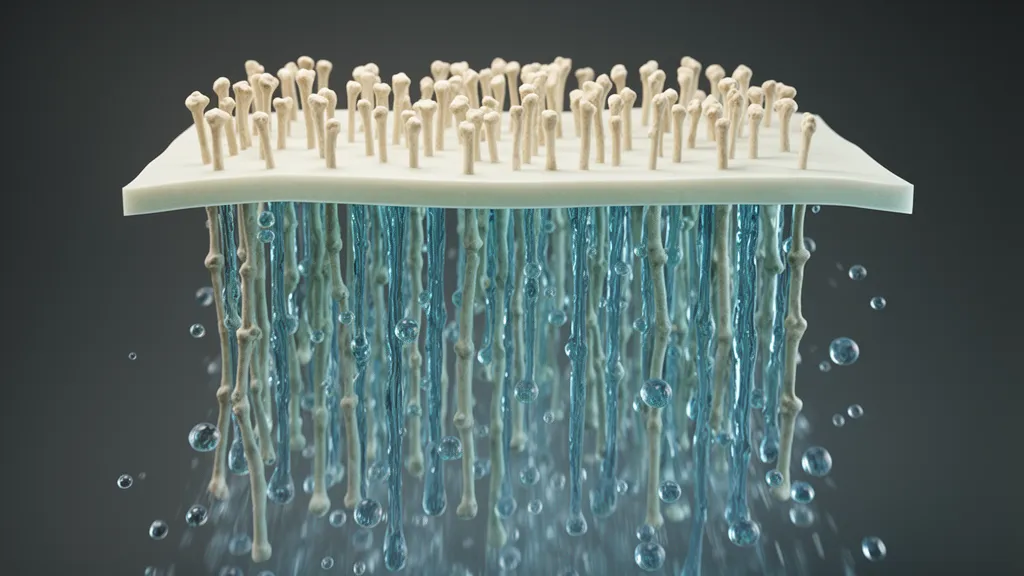
Researchers embedded ultralong hydroxyapatite nanowires in PVDF membranes, raising forward osmosis water flux by about 70 percent while improving antifouling behavior.
No Result View All Result Login HOME NEWS EXPLORE CAREER Companies Jobs Lecturer PhD Studentship Postdoc Research Assistant EVENTS iGEM News Team PHOTOS VIDEO WIKI BLOG COMMUNITY FACEBOOK INSTAGRAM TWITTER HOME NEWS EXPLORE CAREER Companies Jobs Lecturer PhD Studentship Postdoc Research Assistant EVENTS iGEM News Team PHOTOS VIDEO WIKI BLOG COMMUNITY FACEBOOK INSTAGRAM TWITTER No Result View All Result No Result View All Result Home NEWS Science News Technology Bone-Mineral Nanowires Boost Water Flow Through Desalination Membranes by 70 Percent by October 16, 2026 in Technology Reading Time: 5 mins read 0 Bone-Mineral Nanowires Boost Water Flow Through Desalination Membranes by 70 Percent Share on Twitter Share on Linkedin Share on Reddit Share on Telegram Freshwater scarcity is one of the defining challenges of the twenty-first century, and membrane technology sits at the heart of the search for solutions.
In a new study published in Frontiers in Membrane Science and Technology, researchers from Egypt’s Central Metallurgical Research and Development Institute and Italy’s Institute on Membrane Technology report a deceptively simple recipe for making forward osmosis membranes work dramatically better: weave ultralong hydroxyapatite nanowires, a material chemically akin to bone mineral, into a polyvinylidene fluoride polymer matrix.
The resulting mixed-matrix membranes pushed water flux from 2.1 liters per square meter per hour in the pristine polymer to 3.6 LMH, an improvement of roughly 70 percent, while also showing better antifouling behavior and steadier operation over time.
The choice of base polymer is deliberate.
Polyvinylidene fluoride, or PVDF, is a semi-crystalline fluoropolymer prized for its thermal stability, chemical resistance, mechanical strength, and ease of processing, properties that stem from strong dipole interactions between fluorine and carbon atoms along its backbone.
It is also piezoelectric and ferroelectric, which has made it popular in sensors and energy devices as well as membranes.
But in water treatment, PVDF carries a stubborn flaw: it is intrinsically hydrophobic.
Water molecules do not spread readily across its surface, so permeability suffers, fouling takes hold more easily, and operating costs climb as pumps work harder to push water through reluctant pores.
Forward osmosis offers a way around the energy penalty of pressure-driven desalination.
Instead of forcing water through a membrane with hydraulic pressure, as reverse osmosis does, FO exploits the natural tendency of water to diffuse from a solution of low osmotic pressure to one of high osmotic pressure.
A concentrated draw solution, in this study a 2 molar sodium chloride brine, pulls water across a semipermeable membrane from the feed side.
The process runs under mild conditions, achieves high water recovery, and fouls less than pressure-driven systems, but its efficiency hinges on the membrane itself, and hydrophobic PVDF has long been a limiting factor.
Enter hydroxyapatite, the calcium phosphate mineral that gives bones and teeth their strength.
The team synthesized ultralong hydroxyapatite nanowires, abbreviated UHA, using a solvothermal method in which calcium chloride, sodium hydroxide, sodium dihydrogen phosphate, oleic acid, water, and methanol were sealed in a Teflon-lined stainless-steel autoclave and heated at 180 degrees Celsius for 24 hours.
Oleic acid plays a key role, guiding the mineral to grow into exceptionally long, high-aspect-ratio wires rather than bulky particles.
These nanowires are hydrophilic, chemically stable, and biocompatible, and their hydroxyl and phosphate surface groups form strong hydrogen bonds with water and with the surrounding polymer, making them ideal candidates for membrane modification.
Fabrication followed the workhorse route of membrane science: non-solvent-induced phase inversion.
The researchers dispersed UHA nanowires in dimethylformamide by stirring and ultrasonication, dissolved PVDF at about 70 degrees Celsius to form a transparent casting solution, and let it rest overnight to release trapped air.
The solution was then cast onto glass with a knife set to 200 micrometers and plunged into a water bath, where phase inversion locked in the membrane’s asymmetric structure.
Related News
- Water TreatmentWeir advocates early-stage water management to reduce mining risk
- Water TreatmentPentair to Release Third Quarter 2026 Earnings and Host Investor Conference Call on October 27
- Water Treatment11 Missing as Drone Attacks Strike Two Ships Near NATO Waters
- Water TreatmentCM Vijay to lay foundation stone for Rs 3,108 crore Chennai water pipeline project today
- Water TreatmentNod to two sewage treatment projects
- Water TreatmentWilkesboro water treatment plant lands state award