What you need to know about desalination, a growing source of drinking water
As climate change intensifies droughts, disrupts rainfall patterns and fuels wildfires, more regions are turning to the sea for drinking water.
Desalination, which is the process of removing salt from ...
Skip to main Home News Finance Sports More Mail Search the web Advertisement Advertisement Return to Homepage Top Stories: Roller coaster tragedy Cornell rape case Bank of America penalized Kimberly Guilfoyle resigns 2026 midterm initiatives Feds search Ilhan Omar's home Social Security's 2027 COLA Who'll win the House?
South Carolina Senate debate Follow What you need to know about desalination, a growing source of drinking water ANNIKA HAMMERSCHLAG Updated Wed, April 1, 2026 at 1:00 PM UTC 3 min read Add Yahoo as a preferred source to see more of our stories on Google.
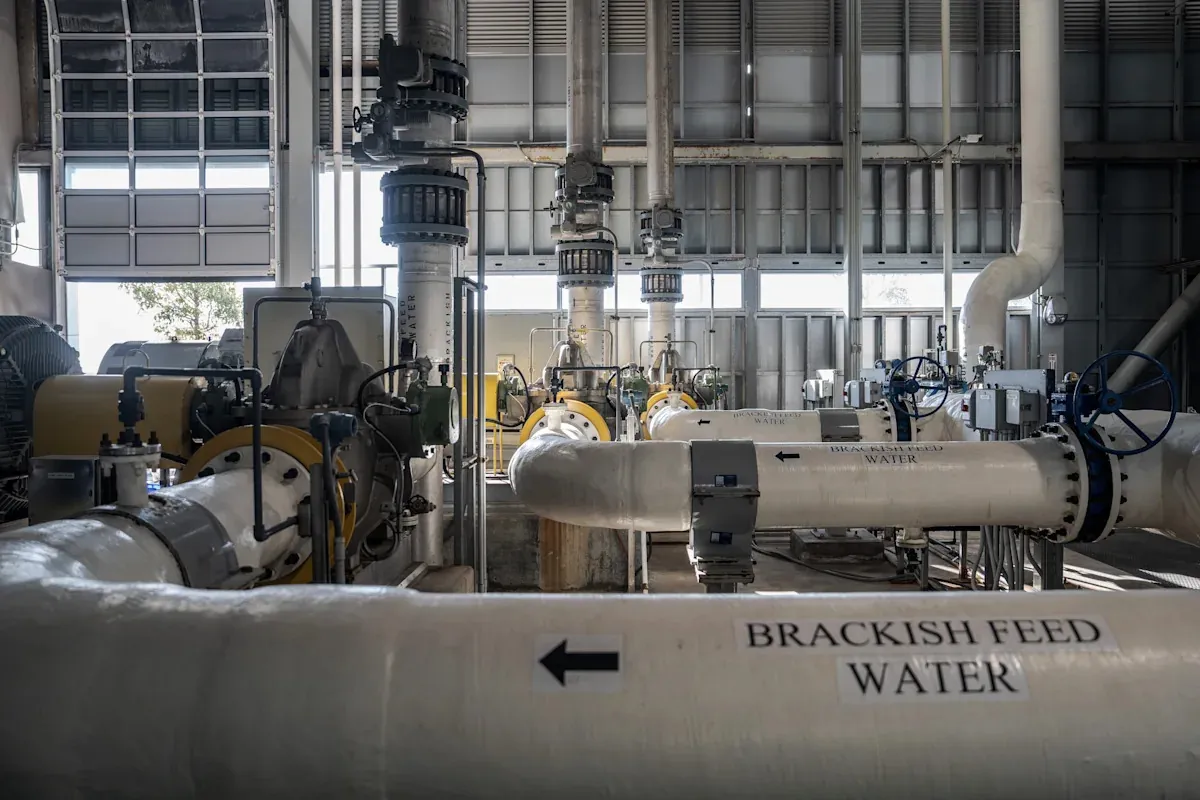
FILE - Pipes carrying brackish feed water run through the Carlsbad desalination plant in Carlsbad, Calif., Dec.
(AP Photo/Annika Hammerschlag, File) (ASSOCIATED PRESS) FILE - Reverse osmosis machinery operates at the Carlsbad desalination plant in Carlsbad, Calif., Dec.
(AP Photo/Annika Hammerschlag, File) (ASSOCIATED PRESS) FILE - Carlsbad desalination plant's intake lagoon is visible on the right and the discharge canal on the left, Dec.
(AP Photo/Annika Hammerschlag, File) (ASSOCIATED PRESS) Climate Solution Desalination 1 of 3 FILE - Pipes carrying brackish feed water run through the Carlsbad desalination plant in Carlsbad, Calif., Dec.
(AP Photo/Annika Hammerschlag, File) (ASSOCIATED PRESS) As climate change intensifies droughts, disrupts rainfall patterns and fuels wildfires, more regions are turning to the sea for drinking water.
Desalination, which is the process of removing salt from seawater, offers a way to produce freshwater in regions that lack sufficient rain, rivers or groundwater to meet demand.
Today, it supplies water to hundreds of millions of people worldwide, from the Middle East to the U.S., and its use is growing as water scarcity deepens.
Most modern desalination plants rely on a process known as reverse osmosis.
Seawater is forced at high pressure through a semi-permeable membrane that allows water molecules to pass through while blocking most salts and other impurities.
The result is freshwater on one side and a highly concentrated salt solution, known as brine, on the other.
Before the water reaches the membrane, the seawater is typically filtered to remove debris and microorganisms that could clog equipment.
Afterward, the freshwater is treated again to meet drinking water standards, often including the addition of minerals.
An older method, thermal desalination, involves heating seawater until it evaporates, then condensing the vapor back into liquid, leaving the salt behind.
While still used in some regions, it is generally more energy intensive.
In the Middle East, countries such as Kuwait and Oman source more than 85% of their drinking water from desalination, according to a 2022 report by the French Institute of International Relations think tank.
It's also widely used in parts of Africa and Australia, as well as in the U.S., particularly in drought prone coastal areas like California and Texas.
In some Pacific Island nations, where rising seas have contaminated groundwater with salt, desalination is becoming an increasingly important source of freshwater.
More than 20,000 desalination plants now operate worldwide, and the industry has been expanding at about 7% annually since 2010, according to the International Desalination and Reuse Association.
The process is energy intensive, with plants worldwide producing between 500 and 850 million tons of carbon emissions annually, according to a 2025 study published in the journal Water Research.
That's nearing the roughly 880 million tons emitted by the entire global aviation industry, an estimate from industry group Air Transport Action Group.
The byproduct of desalination, highly concentrated brine, is typically discharged back into the ocean, where it can harm seafloor habitats and coral reefs by increasing salinity and introducing chemicals used during treatment.
Meanwhile, intake systems can trap and kill fish larvae, plankton and other organisms at the base of the marine food web — losses that can ripple outward, reducing populations of fish and larger predators that depend on them.
Some companies are powering plants with renewable energy, while others are developing more efficient membrane technology to reduce energy consumption.
Related News
- Water Treatment11 Missing as Drone Attacks Strike Two Ships Near NATO Waters
- Water TreatmentFast-track pipeline project raises alarms over water safety, reliance on fossil fuels
- Water TreatmentMexico breaks ground on new desalination plant in Rosarito to bolster region’s water supply
- Water TreatmentKiewit Picked for $757M Corpus Christi Desalination Plant
- Water TreatmentProposed Bacliff desalination plant raises concerns about Galveston Bay’s future
- Water TreatmentCalifornia regulator rejects desalination plant despite historic drought